
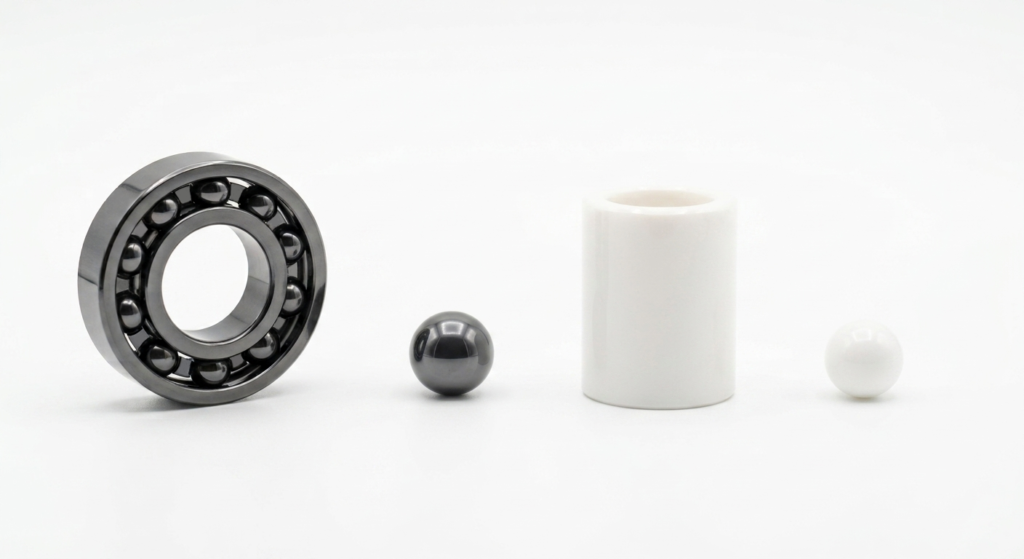
When failure isn’t an option, picking the wrong ceramic material can paralyze your entire production line. Two of the most common heavy-duty contenders are Silicon Nitride (Si₃N₄) and Zirconia (ZrO₂).
Both are tough, but they perform drastically differently under extreme mechanical and thermal stress. Here is a quick breakdown to help you make the right engineering call:
1️⃣ Mechanical Toughness & Hardness
- Zirconia (ZrO₂ / Y-TZP): Highest fracture toughness among monolithic ceramics (≈6-8 MPa·m¹/²). Excellent for high-impact and heavy-wear applications at room/moderate temperatures.
- Silicon Nitride (Si₃N₄): Slightly lower room-temp toughness than Zirconia, but higher hardness (HV1500+) and superior wear resistance under dry friction or high-speed sliding.
2️⃣ Thermal Shock Resistance (The Ultimate Differentiator) ⚡
- Zirconia (ZrO₂): Low thermal conductivity (∼2.5 W/m·K) and higher thermal expansion coefficient (∼10.5 × 10⁻⁶/K). Risk: Susceptible to micro-cracking during rapid temperature changes (>250°C thermal shock).
- Silicon Nitride (Si₃N₄): High thermal conductivity (∼30 W/m·K) combined with an ultra-low expansion coefficient (∼3.2 × 10⁻⁶/K). Result: Outstanding thermal shock resistance (ΔT > 800°C without cracking).
💡 The Engineering Verdict:
👉 Choose Zirconia (ZrO₂) if: You need maximum fracture resistance at temperatures below 300°C, high bending strength, and budget-friendly precision components (e.g., fluid control valves, low-speed wear rings).
👉 Upgrade to Silicon Nitride (Si₃N₄) if: Your application involves high-speed friction, aggressive thermal cycles, or elevated temperatures above 500°C (e.g., ceramic bearing balls, molten metal handling, aerospace seals).
📊 Designing a component for extreme conditions?
DM us your working conditions (Temperature / Load / Medium) or drop your STEP/CAD file at https://hephys-solutions.com, and our team will run a quick material selection & DFM assessment for you.