When engineers evaluate ceramics for high-cycle dynamic stress, they often look at macro hardness (HV) or flexural strength. However, in semiconductor plasma chambers or high-speed aerospace seals, micro-crack initiation is what leads to sudden, unpredicted field failure.
Standard isotropic ceramics fail because cracks propagate in a straight path once stress intensity exceeds KIC. So why does Gas-Pressure Sintered Silicon Nitride (GPS-Si₃N₄) exhibit unparalleled resistance to thermal shock degradation?
The Microstructural Mechanism:
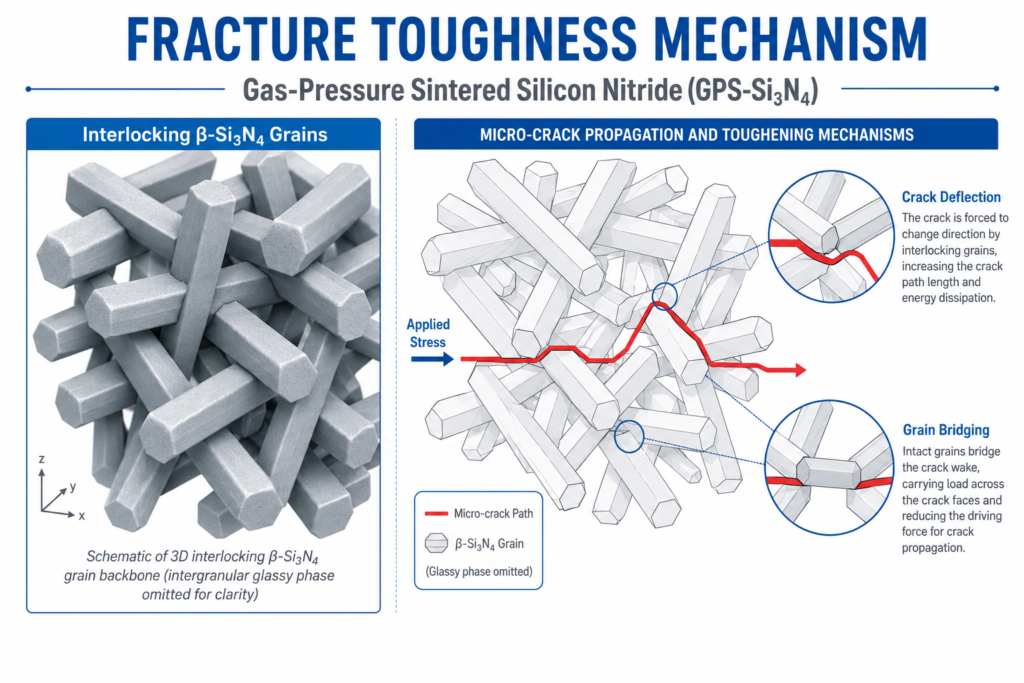
- Self-Reinforcing Interlocking Network: During liquid-phase sintering at high N2 pressure, fine α-Si₃N₄ dissolves and reprecipitates as elongated, needle-like β-Si₃N₄ grains (aspect ratio up to 5:1~10:1).
- Crack Bridging & Deflection: When a micro-crack begins to form under steep thermal gradients, the crack path is forced to tortuously bend around the elongated β grains, absorbing fracture energy via grain bridging and pull-out mechanisms.
- Optimized Grain Boundary Phase: By controlling the sintering additives (Y₂O₃/Al₂O₃ system), the intergranular glass phase thickness is minimized to keep high-temperature creep resistance intact up to 1200℃.
Engineering Takeaway for Equipment Designers:
If your ceramic components undergo rapid 1000°C/min cycling, specifying “Silicon Nitride” isn’t enough. You must ensure the material has a tailored, high-aspect-ratio β-phase grain structure.
Analyzing a component failure or optimizing crack tolerance for your next-gen equipment?
At Hephys Solutions, we focus on microstructural integrity and precise DFM tolerances (±0.002mm) for Si₃N₄、AlN、Al₂O₃ and ZrO₂.
Drop your CAD model or application conditions at https://hephys-solutions.com/contact/ and let’s discuss microstructural optimization.