
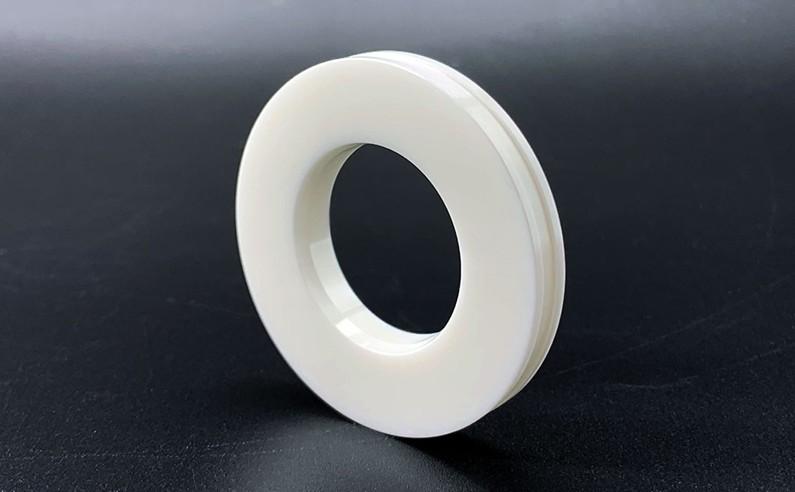
Zirconia ceramics are widely used in precision engineering because of their high strength, excellent wear resistance, and comparatively high fracture toughness among advanced structural ceramics.
However, selecting zirconia based on initial mechanical properties alone can be misleading.
For certain zirconia grades, prolonged exposure to moisture and elevated temperatures may trigger a gradual microstructural change known as low-temperature degradation (LTD), or hydrothermal aging. This phenomenon can affect surface integrity and mechanical reliability over time.
For engineers designing ceramic components for pumps, valves, precision mechanisms, and other demanding environments, understanding this mechanism is essential to making informed material and process decisions.
1. What Is Hydrothermal Aging in Zirconia?
Zirconia (ZrO₂) can exist in different crystallographic phases, including monoclinic, tetragonal, and cubic structures. The phase distribution depends on factors such as temperature, stabilizer content, composition, and microstructure.
In many high-strength zirconia ceramics, yttria is added to stabilize the tetragonal phase at room temperature. These materials are commonly known as yttria-stabilized tetragonal zirconia polycrystals (Y-TZP).
Under certain combinations of temperature, humidity, and exposure time, the metastable tetragonal phase near the surface may transform into the monoclinic phase.
This transformation involves a local volume expansion and can generate stresses within the microstructure. As the transformation progresses, it may contribute to surface roughening, microcracking, grain pullout, and changes in mechanical performance.
Importantly, hydrothermal aging does not affect every zirconia formulation in the same way. Its severity depends on the material grade, stabilizer distribution, grain size, residual stresses, surface condition, and actual service environment.
Engineering takeaway: A zirconia component that performs well during initial inspection may still require aging-related evaluation when long-term exposure to hot moisture is part of its intended service conditions.
2. Why Does the Tetragonal-to-Monoclinic Transformation Matter?
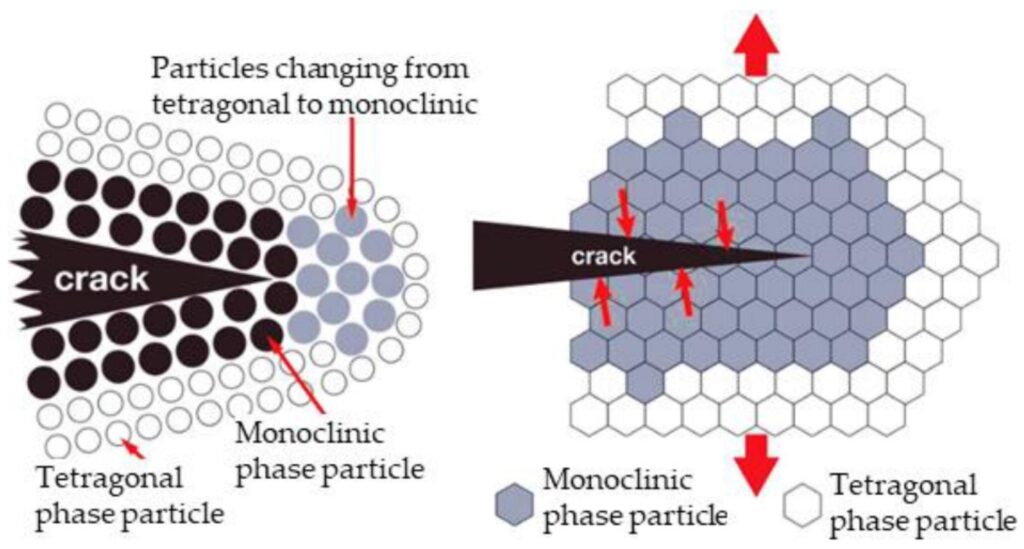
The transformation mechanism is closely related to one of zirconia’s most valuable properties: transformation toughening.
When a crack begins to propagate through an appropriately engineered zirconia microstructure, stress near the crack tip can trigger the transformation of metastable tetragonal grains into the monoclinic phase.
The associated volume expansion generates local compressive stresses that oppose crack propagation. This mechanism can improve fracture toughness compared with many other structural ceramics.
However, the same transformation can be undesirable when it occurs progressively across an exposed surface under hydrothermal conditions.
The distinction is important:
- Stress-induced transformation: A localized response that can help resist crack growth.
- Hydrothermal aging: A time-dependent transformation that may spread through the surface microstructure and contribute to degradation.
The goal is therefore not simply to maximize the amount of transformable tetragonal phase. It is to engineer a microstructure that provides a suitable balance of toughness, stability, and resistance to the intended service environment.
3. Which Operating Conditions Should Engineers Evaluate?
Hydrothermal aging is influenced by several interacting variables. No single temperature or exposure duration can be used as a universal prediction of component life.
Temperature and moisture
Higher temperatures generally accelerate hydrothermal aging reactions in susceptible zirconia grades. Water vapor and liquid-water exposure may both be relevant, depending on the application.
Engineers should distinguish between continuous wet operation, intermittent washing, steam exposure, and dry high-temperature service.
Material composition and stabilizer distribution
Yttria content alone does not fully determine aging resistance. The distribution of stabilizer within the grains, phase composition, and grain-boundary characteristics can also influence stability.
Different zirconia grades may therefore behave differently under the same exposure conditions.
Grain size and microstructure
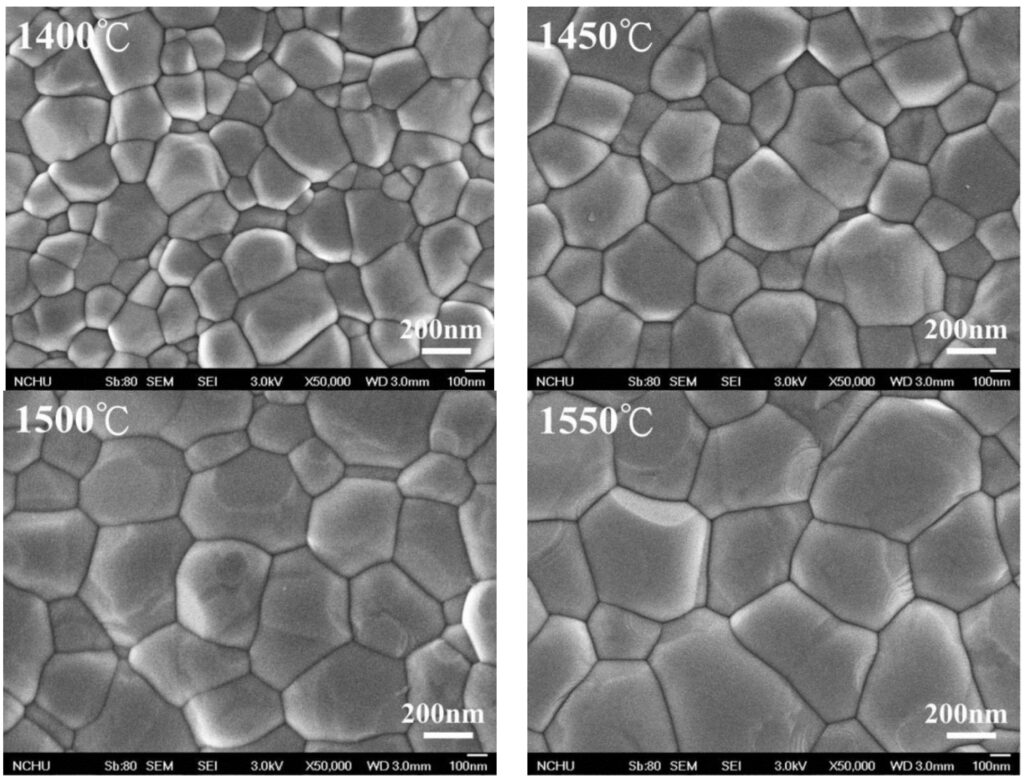
Grain size and microstructural uniformity can affect phase stability and transformation kinetics. A fine-grained microstructure is often beneficial, but it should not be treated as a guarantee against aging.
Surface finishing and residual stress
Grinding, polishing, machining damage, and residual stresses can influence surface integrity and transformation behavior.
For precision parts, surface preparation should be considered alongside bulk material properties rather than as an isolated cosmetic requirement.
4. How Can Engineers Assess Aging Resistance?
A robust material qualification process should combine material characterization, controlled exposure testing, and application-specific performance evaluation.
Depending on the component and risk level, useful methods may include:
X-ray diffraction (XRD)
XRD can help identify crystalline phases and evaluate changes in monoclinic phase content before and after exposure. Measurement methods and sampling locations should be kept consistent when comparing results.
Scanning electron microscopy (SEM)
SEM can help reveal surface morphology, grain-boundary changes, microcracks, and other features associated with degradation. It complements rather than replaces quantitative phase analysis.
Surface roughness measurement
Profilometry or another suitable surface measurement technique can establish whether exposure or finishing changes the functional surface.
Mechanical testing
Flexural strength, hardness, fracture toughness, or other relevant properties may be evaluated according to the component’s failure modes and the applicable test methods. These measurements are not interchangeable: hardness alone cannot establish fracture resistance or aging durability.
Accelerated hydrothermal testing
For suitable zirconia grades, accelerated aging protocols can help compare material performance under controlled conditions. For example, ISO 13356 specifies requirements for certain yttria-stabilized tetragonal zirconia materials used in surgical implants. Its scope should not be assumed to cover every industrial zirconia grade or application.
Accelerated test results must be interpreted carefully. A short laboratory exposure does not automatically translate into a specific number of years in service unless a validated correlation exists.
5. Design Considerations for Precision Zirconia Components
Material selection is only one part of long-term reliability. Component geometry, machining quality, and operating conditions also matter.
Avoid unnecessary stress concentrations
Sharp internal corners, abrupt section changes, and poorly designed transitions can increase local stresses. Where feasible, appropriate radii and smoother geometric transitions can reduce these concentrations.
Specify the functional surface
A bearing surface, sealing face, locating feature, and non-contact exterior surface may have different requirements.
Rather than applying an unnecessarily tight finish specification to every surface, define the critical areas, required roughness, dimensional tolerances, and inspection method on the engineering drawing.
Consider the entire operating environment
A component exposed to warm water, cleaning chemicals, cyclic loading, or repeated thermal changes should be evaluated against the combined service conditions.
Hydrothermal stability is one consideration; wear, chemical compatibility, thermal cycling, and mechanical loading may also govern component life.
Qualify the actual material grade
“Zirconia” is not a complete engineering specification.
Where long-term reliability is important, identify the relevant zirconia composition and grade, define critical performance requirements, and request supporting material data. For demanding applications, consider whether aging tests and post-exposure inspections should form part of the qualification plan.
6. What Should Be Included in a Zirconia Component Specification?

When requesting a custom zirconia component, engineers can improve design reviews and supplier communication by documenting the following information:
- Material: Zirconia grade, stabilizer system, and any relevant material specification.
- Geometry: CAD model or technical drawing, including critical dimensions and tolerances.
- Surface requirements: Functional surface locations, roughness requirements, and finishing method where necessary.
- Service environment: Temperature range, moisture or steam exposure, chemical contact, and operating cycles.
- Mechanical requirements: Contact loads, friction conditions, wear requirements, and potential impact or bending loads.
- Validation: Required inspection reports, applicable test methods, and any aging or environmental qualification requirements.
These details help manufacturers evaluate feasibility and identify potential risks before production begins.
Conclusion: Specify for Long-Term Performance, Not Just Initial Strength
Zirconia’s transformation-toughening mechanism makes it a valuable engineering ceramic, but phase stability and environmental exposure should not be overlooked.
For applications involving hot moisture or long service intervals, engineers should evaluate the specific zirconia grade, microstructure, surface condition, and operating environment together.
The most reliable material choice is not necessarily the grade with the highest headline strength or hardness. It is the material whose verified properties and manufacturing quality match the component’s actual service requirements.
Need a custom zirconia component for your application?
Hephys Solutions supports custom advanced ceramic components based on engineering drawings and application requirements. Share your component geometry, operating conditions, critical tolerances, and material requirements with our team to discuss a suitable manufacturing and qualification approach.
Contact: info@hephys-solutions.com