
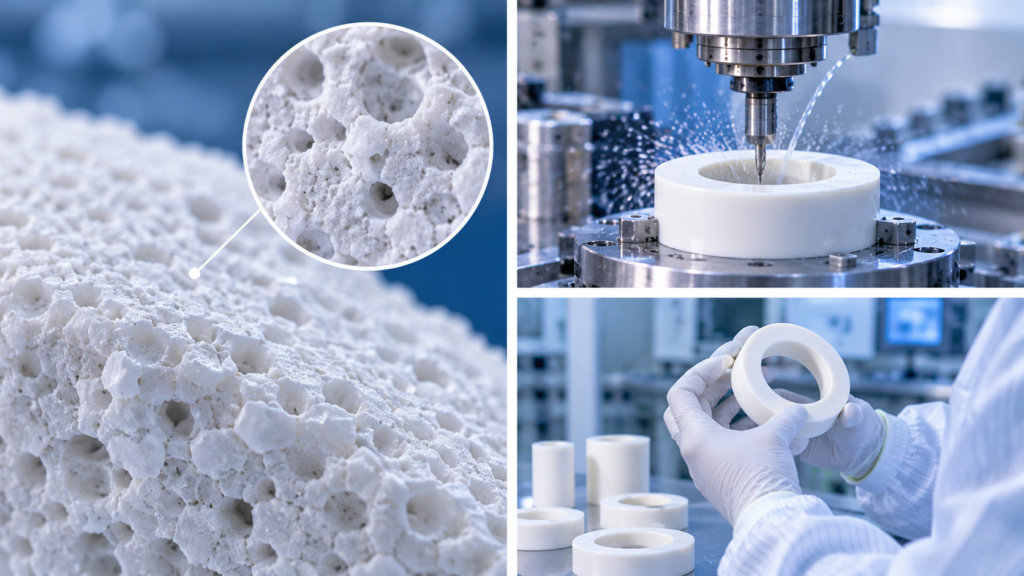
In semiconductor manufacturing, vacuum equipment and high-precision industrial systems, even a small contamination source can affect process stability.
Engineers often select technical ceramics for their electrical insulation, thermal stability, wear resistance and dimensional reliability. Alumina, aluminum nitride (AlN), silicon nitride (Si₃N₄) and other advanced ceramics are widely used in demanding equipment environments.
However, selecting a ceramic material based on its bulk properties is only part of the engineering process.
A ceramic component may meet its dimensional specifications and still introduce unwanted moisture, residual gases or particles into a vacuum system.
Why does this happen?
The answer may involve material porosity, surface condition, machining residues, cleaning procedures and component handling.
For engineers developing vacuum-compatible ceramic components, understanding these factors is essential to reducing contamination risks and improving equipment reliability.
1. Why Does Outgassing Matter in Vacuum Systems?
Outgassing refers to the release of gases or vapors from a material or component after it has been placed in a vacuum environment.
For ceramic components, potential contributors include:
- Adsorbed moisture on exposed surfaces
- Gas retained in accessible pores or surface defects
- Residual substances from manufacturing and handling
- Cleaning-agent residues
- Organic materials introduced during assembly or packaging
The actual outgassing behavior depends on the ceramic composition, manufacturing process, surface area, porosity, storage history and operating conditions.
In a vacuum chamber, released gases increase the gas load that the pumping system must remove.
This can result in:
- Longer pump-down time
- Increased residual gas levels
- Reduced vacuum stability
- Potential interference with sensitive process environments
For high-vacuum and semiconductor applications, these factors should be considered during component design and supplier qualification.
Engineering takeaway: A ceramic material should not automatically be considered vacuum-compatible simply because it is inorganic or has a high sintering temperature. The finished component and its manufacturing history matter.
2. How Does Ceramic Porosity Affect Vacuum Performance?
Porosity is an important consideration when evaluating ceramic components for vacuum service.
Even when a ceramic appears dense and smooth, its internal microstructure may contain pores or other features that influence gas retention and release.
The relationship between porosity and outgassing is not determined by porosity alone. Pore accessibility, pore size distribution, surface area, material composition and previous exposure conditions also matter.
For example, two alumina components manufactured using different processing routes may show different vacuum behavior, even if their nominal material designation is similar.
This is why engineers should consider more than the material name when specifying vacuum components.
Important parameters include:
- Ceramic grade and composition
- Bulk density and apparent porosity
- Surface condition and accessible surface area
- Manufacturing and finishing processes
- Cleaning and drying procedures
- Required vacuum level and operating temperature
For applications with demanding vacuum requirements, material data and component-level testing should be evaluated together.
3. Can Ceramic Machining Introduce Contamination?
Yes. Machining and finishing operations can influence the cleanliness of a ceramic component.
Advanced ceramics are commonly processed through a combination of green machining, sintering, diamond grinding, lapping, polishing and, where appropriate, laser machining.
Each operation has different process considerations.
Potential contamination sources include:
Grinding and polishing residues
Abrasive particles or processing residues may remain on the component surface if cleaning is insufficient.
Machining-induced surface damage
Localized chipping, microcracks or damaged surface regions may create areas that are more difficult to clean consistently.
Embedded contaminants
Depending on the material and processing route, abrasive or other foreign particles may become trapped in surface defects or accessible pores.
Handling contamination
Fingerprints, dust, packaging residues and workshop contaminants can be introduced after machining and inspection.
A visually clean ceramic part is not necessarily a component that meets a defined cleanliness requirement.
For critical vacuum applications, the manufacturer and equipment designer should agree on the required cleaning, inspection and packaging procedures.
4. Why Surface Finish Is Not the Same as Cleanliness
A smoother ceramic surface may be beneficial in applications where particle retention, friction or cleaning accessibility are important.
However, surface roughness alone cannot establish whether a component is suitable for a vacuum or semiconductor process.
Consider two ceramic components:
- Component A has a polished surface but contains residual cleaning-agent contamination.
- Component B has a controlled machined surface with an appropriate cleaning and packaging process.
The lower Ra value of Component A does not automatically make it the cleaner component.
Engineers should distinguish between several different requirements:
Surface roughness
Describes the surface texture and is commonly specified using parameters such as Ra.
Surface integrity
Considers defects such as cracks, chips, grinding damage and other localized imperfections.
Chemical cleanliness
Addresses residual substances, organic contamination and other unwanted chemical species.
Particulate cleanliness
Addresses particles remaining on or released from the component.
Vacuum outgassing performance
Evaluates the release of gases or vapors under defined vacuum conditions.
These properties are related, but they are not interchangeable.
A useful engineering drawing should identify the functional surfaces and specify the actual cleanliness or inspection requirements rather than relying only on a general instruction such as “high surface quality.”
5. How Should Engineers Select Ceramic Materials for Vacuum Applications?
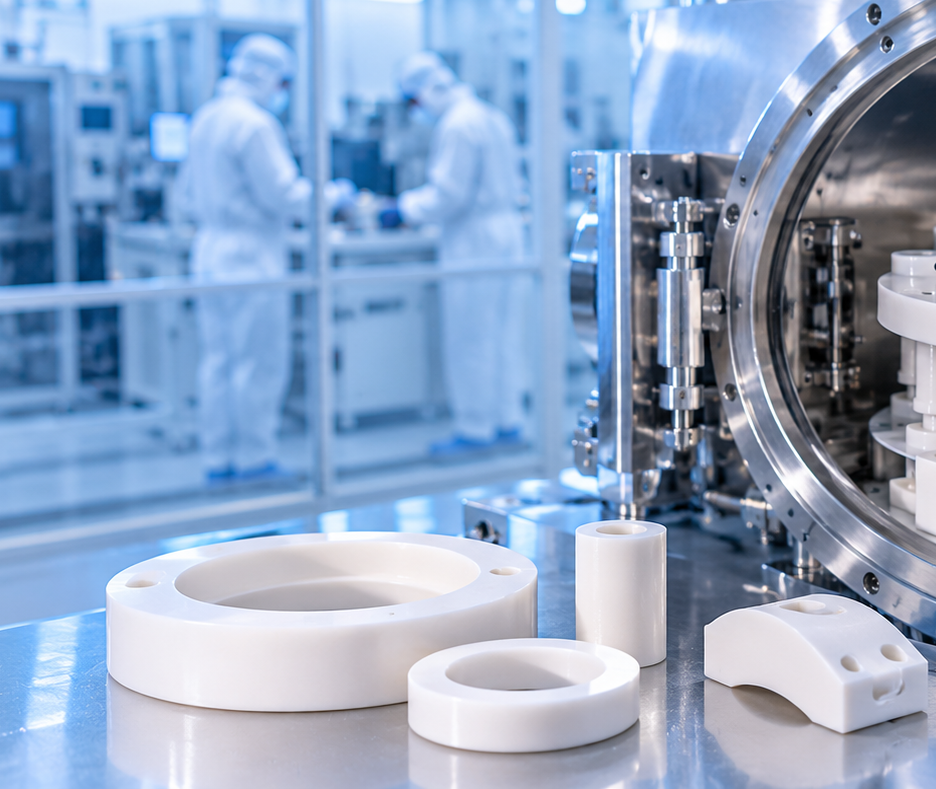
Different ceramic families offer different combinations of mechanical, thermal, electrical and chemical properties.
The appropriate material depends on the operating environment and the function of the component.
Alumina (Al₂O₃)
Alumina is widely used in electrical insulation, vacuum feedthroughs, structural supports and precision equipment components.
Its high-temperature capability and electrical insulation make it a practical option for many industrial and semiconductor applications.
However, the selected purity, density, manufacturing route and surface condition should be evaluated against the actual vacuum requirements.
Aluminum Nitride (AlN)
AlN combines high thermal conductivity with electrical insulation.
It is useful in applications where heat transfer and electrical isolation are both important, such as thermal management components and selected semiconductor equipment parts.
For vacuum-related applications, engineers should also consider the grade, surface condition, machining process and cleaning compatibility.
Silicon Nitride (Si₃N₄)
Silicon nitride offers high mechanical strength, wear resistance and thermal shock resistance.
It may be suitable for mechanically demanding components exposed to thermal cycling or repeated contact.
Its suitability for a particular vacuum environment should be assessed using the actual material grade and finished-component requirements.
Zirconia (ZrO₂)
Zirconia is valued for its high fracture toughness relative to many other advanced ceramics and its wear resistance.
It can be considered for precision mechanical and wear-related components, provided that the application temperature, chemical environment and vacuum requirements are compatible with the selected grade.
Important: No ceramic material should be selected for vacuum service based on its material family alone. Grade, microstructure, processing, cleaning and assembly conditions all contribute to final performance.
6. Practical Ways to Reduce Contamination Risks
A reliable ceramic component specification should address the complete manufacturing and handling process.
Here are five practical considerations.
1. Specify the material grade
Avoid using only generic descriptions such as “alumina ceramic” or “high-purity ceramic.”
Where necessary, identify the material grade, purity, density or other relevant characteristics.
2. Define critical surface requirements
Identify the surfaces that contact the vacuum environment or sensitive process areas.
Specify roughness, flatness, dimensional tolerances and visual inspection requirements according to their actual function.
3. Establish a suitable cleaning process
Cleaning methods must be compatible with the ceramic material, surface condition and any additional coatings or metal inserts.
The process should also address rinsing, drying and the prevention of recontamination.
4. Control handling and packaging
After cleaning, components can become contaminated again through handling, storage or unsuitable packaging.
For sensitive applications, define appropriate protective packaging, handling procedures and storage conditions.
5. Validate the finished component
When vacuum performance is critical, consider component-level evaluation under defined conditions.
Depending on the application, this may include:
- Outgassing measurements
- Residual gas analysis (RGA)
- Particle inspection
- Surface contamination assessment
- Thermal conditioning or bake-out evaluation
- Dimensional and visual inspection
Testing methods and acceptance limits should be selected according to the required vacuum level and process sensitivity.
A material datasheet alone cannot guarantee the performance of a finished ceramic component.
7. What Should You Include in a Vacuum Ceramic Component RFQ?
If you are sourcing custom ceramic parts for vacuum equipment or semiconductor manufacturing, providing the following information can help accelerate technical evaluation.
Material information
- Preferred ceramic material or grade
- Purity and density requirements, if specified
- Whether alternative materials can be considered
Component information
- 2D engineering drawing
- 3D CAD model, preferably STEP format
- Critical dimensions and geometric tolerances
- Surface roughness and finishing requirements
Operating conditions
- Required vacuum level
- Operating and bake-out temperature
- Process gases or chemical exposure
- Thermal cycling conditions
- Mechanical loading or assembly requirements
Cleanliness requirements
- Particle contamination limits, if defined
- Chemical cleanliness requirements
- Outgassing or RGA acceptance criteria
- Cleaning and packaging expectations
Project information
- Prototype quantity
- Expected production volume
- Inspection and documentation requirements
The more clearly these requirements are defined, the easier it becomes to evaluate material suitability, manufacturing feasibility and inspection methods before production begins.
Conclusion: Vacuum Compatibility Starts Before Installation
Vacuum performance is not determined by ceramic material properties alone.
Porosity, surface condition, machining residues, cleaning procedures, handling and packaging can all influence the behavior of the finished component.
For engineers developing semiconductor equipment, vacuum chambers and precision industrial systems, these factors should be considered early in the design and sourcing process.
A well-designed ceramic component is not simply one that meets its drawing dimensions. It must also be manufactured, cleaned and handled in a way that supports its intended operating environment.
Need Custom Ceramic Components for Vacuum or Semiconductor Equipment?
At Hephys Solutions, we support customized advanced ceramic components based on engineering drawings and application requirements.
Our material options include alumina, zirconia, aluminum nitride, silicon nitride and boron nitride.
Whether you are developing ceramic insulating rings, precision supports, spacers, structural components or other customized parts, our team can review your drawings and discuss material and manufacturing considerations.
To start a technical discussion, send us:
- Your 2D drawing or 3D CAD model
- Preferred ceramic material, if known
- Operating vacuum and temperature conditions
- Critical tolerances and surface requirements
- Cleanliness or inspection expectations
- Prototype or production quantity
Contact Hephys Solutions to discuss your next custom ceramic component project.
Email: info@hephys-solutions.com