Hexagonal Boron Nitride (h-BN) is often celebrated as the “White Graphite” of technical ceramics—it’s thermally conductive, electrically insulating, chemically inert, and exceptionally machinable with standard carbide tools.
However, many design engineers fall into a critical failure trap during prototype development: Ignoring the directional orientation of hot pressing.
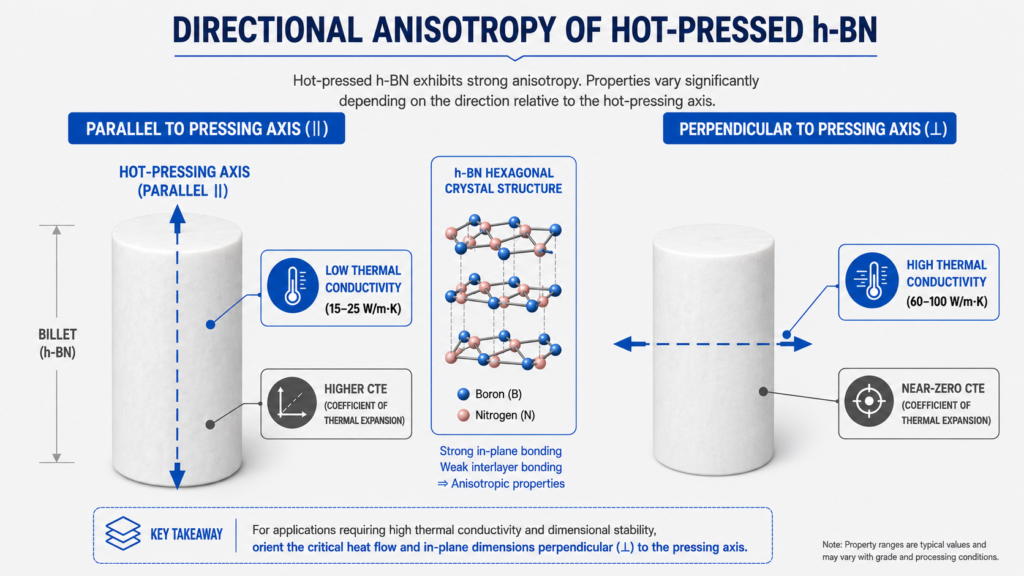
Because h-BN possesses a 2D layered crystal structure (similar to graphite with alternating B and N atoms), its thermomechanical properties vary dramatically depending on whether they are measured Parallel (∥) or Perpendicular (⊥) to the hot-pressing axis:
1. Thermal Expansion Coefficient (CTE) Mismatch:
- Parallel to Pressing Axis (∥): Higher CTE (~2.5~4.0×10⁻⁶/K).
- Perpendicular to Pressing Axis (⊥): Extremely low or even negative CTE (~-0.5~1.0×10⁻⁶/K).
- Risk: If a cylindrical h-BN insulating sleeve is machined without marking the pressing axis, thermal expansion during high-temperature operation (>1500℃ in inert atmosphere) will cause uneven radial stress, leading to binding or cracking against metal mating parts.
2. Thermal Conductivity Directionality:
- Thermal dissipation along the a-b planes (⊥to pressing) can reach , whereas heat flow across the layers (∥ to pressing) drops down to 15∼25 W/m·K.
Design & DFM Recommendation: When releasing STEP files or engineering drawings for h-BN components (e.g., vacuum furnace insulators, PVD sputtering shields, or plasma arc nozzles), always specify the required grain/pressing orientation relative to your primary thermal and mechanical load vectors.
Working on high-precision h-BN, AlN, or Zirconia/Alumina custom components? We don’t just supply ceramics; we audit engineering orientation, grain structure, and thermal compatibility. Welcome to contact us anytime.